

Dozzle - dozzle.dev
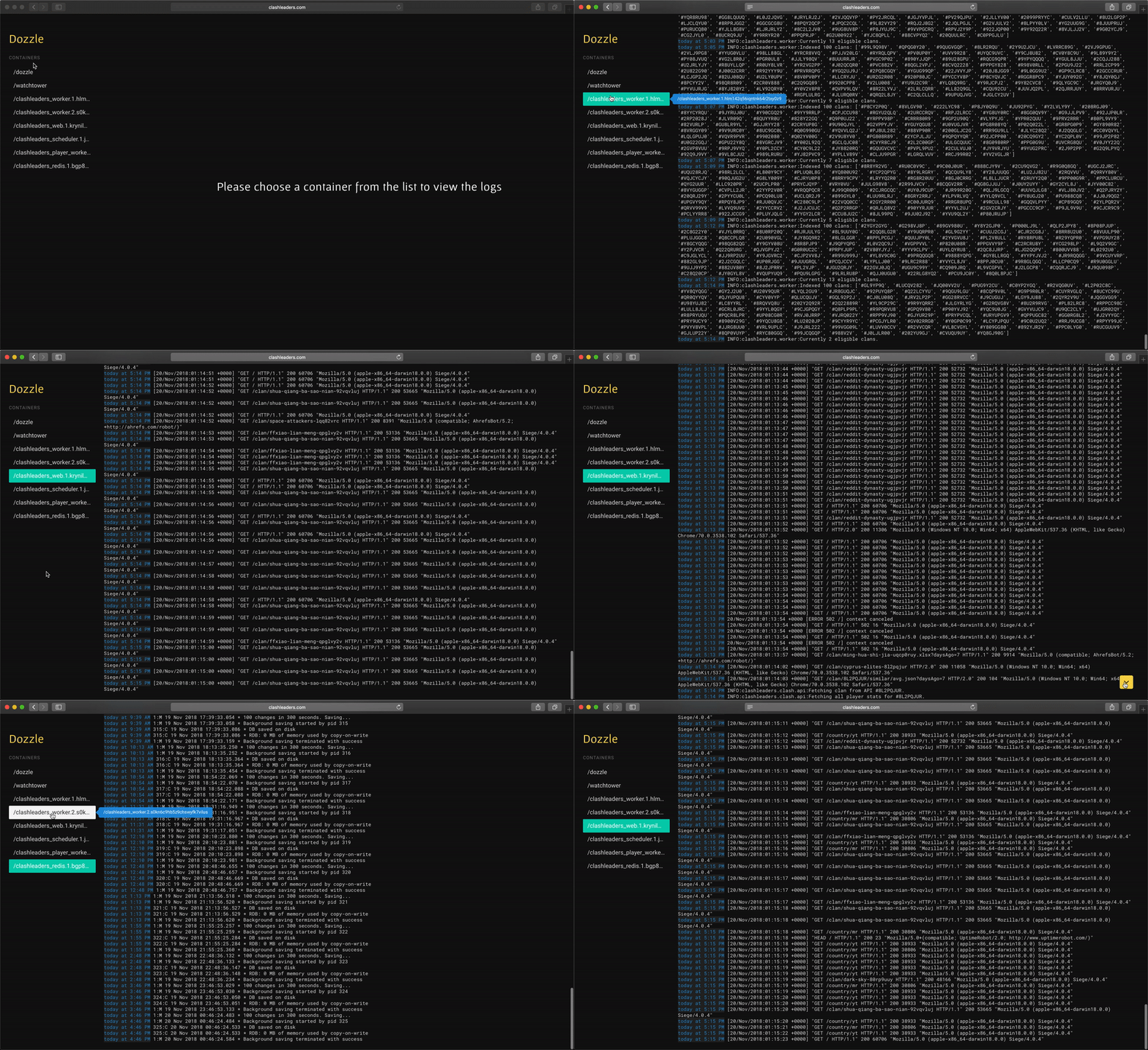
Dozzle is a lightweight, web-based application for monitoring Docker logs in real time. It doesn't store any log files—it's designed purely for live log viewing.




[!NOTE] If you like Dozzle, check out
dtop, a top-like application for monitoring Docker containers. It integrates with Dozzle to link directly to container logs.
Features
- Intelligent fuzzy search for container names
- Search logs using regex
- Search logs using SQL queries
- Small memory footprint
- Split screen for viewing multiple logs
- Live stats with memory and CPU usage
- Multi-user authentication with support for forward proxy authorization
- Swarm mode support
- Agent mode for monitoring multiple Docker hosts
- Dark mode
Dozzle has been tested with hundreds of containers. However, it doesn't support offline searching. Products like Loggly, Papertrail, or Kibana are better suited for full search capabilities.
Getting Started
Dozzle is a small container (7 MB compressed). Pull the latest release with:
$ docker pull amir20/dozzle:latest
Running Dozzle
The simplest way to use Dozzle is to run the Docker container. Mount the Docker Unix socket with --volume to /var/run/docker.sock:
$ docker run --name dozzle -d --volume=/var/run/docker.sock:/var/run/docker.sock -v dozzle_data:/data -p 8080:8080 amir20/dozzle:latest
Dozzle will be available at http://localhost:8080/.
Here is a Docker Compose example:
services:
  dozzle:
    container_name: dozzle
    image: amir20/dozzle:latest
    volumes:
      - /var/run/docker.sock:/var/run/docker.sock
      - dozzle_data:/data
    ports:
      - 8080:8080
volumes:
  dozzle_data:
For advanced options like authentication, remote hosts, or common questions, see the documentation at dozzle.dev.
Image Tags
Images are published to both Docker Hub and ghcr.io with identical tags.
| Tag | Description |
|---|---|
latest |
Most recent release. Recommended for most users. |
v10.6.15 |
An exact release. Pin this for reproducible deployments. |
v10.6 |
Latest patch within that minor version. Picks up bug fixes only. |
v10 |
Latest release within that major version. Picks up new features too. |
alpine |
Same as latest, but on an Alpine base instead of scratch. |
v10.6.15-alpine, v10.6-alpine, v10-alpine |
Alpine variants of the version tags above. |
main |
Built from the main branch on every push. Unreleased and unstable. |
pr-1234, pr-1234-alpine |
Built from pull request #1234, for testing a fix before it ships. |
The default images are built FROM scratch and contain only the Dozzle binary, which is why they are around 7 MB compressed. That also means there is no shell inside them. Use the alpine variants only if something in your setup needs one, most commonly platforms that bind-mount a #!/bin/sh wrapper over the container entrypoint such as Unraid's per-container Tailscale toggle. See the FAQ for details.
Avoid latest and main in production. latest moves on every release and main is unreleased code.
Swarm Mode
Dozzle works with Docker Swarm. You can run Dozzle as a global service:
$ docker service create --name dozzle --env DOZZLE_MODE=swarm --mode global --mount type=bind,source=/var/run/docker.sock,target=/var/run/docker.sock -p 8080:8080 amir20/dozzle:latest
See the Swarm Mode documentation for more details.
Agent Mode
Dozzle can monitor multiple Docker hosts. Run Dozzle in agent mode with:
$ docker run -v /var/run/docker.sock:/var/run/docker.sock -p 7007:7007 amir20/dozzle:latest agent
See the Agent Mode documentation for more details.
Technical Details
Dozzle uses automatic API negotiation, which works with most Docker configurations. Dozzle also works with Colima and Podman.
Dozzle requires Docker Engine 19.03 or newer (API version 1.40+). Older daemons are not supported by the underlying Docker SDK.
Installation on Podman
By default, Podman doesn't have a background process, but you can enable the remote socket for Dozzle to work.
First, verify if your Podman installation has the remote socket enabled:
podman info
If you see output like this under the remote socket key, it's already enabled:
  remoteSocket:
    exists: true
    path: /run/user/1000/podman/podman.sock
If it's not enabled, follow this tutorial to enable it.
Once the Podman remote socket is enabled, you can run Dozzle:
podman run --volume=/run/user/1000/podman/podman.sock:/var/run/docker.sock -d -p 8080:8080 docker.io/amir20/dozzle:latest
Nothing else is needed. Dozzle works out a stable host id for Podman on its own, since Podman is daemonless and has no engine identity to report.
[!NOTE] Older versions of this page told you to create a
/var/lib/docker/engine-idfile to preventhost not founderrors. That never worked. Podman's Docker-compatible/infoendpoint does not read any file, it returns a new random UUID on every call, so Dozzle now derives the id instead. You can delete the file.
For more details, see Podman Info or the FAQ.
Security
Dozzle supports file-based authentication and forward proxy authentication with tools like Authelia. See the documentation at https://dozzle.dev/guide/authentication.
Analytics
Dozzle collects anonymous user configurations using Google Analytics. Why? Dozzle is an open source project with no funding, so there's no time for formal user studies. Analytics help prioritize features and fixes based on how people use Dozzle. This data is completely public and can be viewed live on the Data Studio dashboard.
To disable analytics, use the --no-analytics flag.
Environment Variables and Configuration
Dozzle follows the 12-factor model. Configuration can be done via CLI flags or environment variables. See the documentation at dozzle.dev/guide/supported-env-vars for more details.
Support
There are many ways to support Dozzle:
- Use it! Write about it! Star it! If you love Dozzle, drop me a line and tell me what you love.
- Blog about Dozzle to spread the word. If you're good at writing, send PRs to improve the documentation at dozzle.dev.
- Sponsor my work at https://www.buymeacoffee.com/amirraminfar

License
Building
Want to contribute? Great! Dozzle has two parts: a Go backend that talks to Docker, and a Vue frontend that runs in the browser. You don't need to know both — pick the side that matches what you want to change. For documentation fixes, no setup is needed at all; just edit the file on GitHub.
1. Install the prerequisites
You'll need Go (1.25+), Node.js, Bun, and protoc.
On macOS, you can install everything in one go:
brew install go node oven-sh/bun/bun protobuf
On Linux (Debian/Ubuntu):
sudo apt install golang nodejs protobuf-compiler
curl -fsSL https://bun.com/install | bash
On Windows, we recommend using WSL2 and following the Linux instructions.
2. Clone and set up
git clone https://github.com/amir20/dozzle.git
cd dozzle
bun install                 # installs frontend dependencies
go install tool             # installs Go build tools listed in go.mod (air, protoc-gen-go, etc.)
make generate               # generates TLS certificates and protobuf code (only needed once)
3. Start the dev server
make dev
Open http://localhost:3100 — you should see the Dozzle UI connected to your local Docker. Both the frontend and backend reload automatically when you save a file.
Making your first change
Try editing assets/pages/index.vue and saving — the browser updates instantly. For backend changes, edit any .go file and the server will restart on its own.
Troubleshooting
- Nothing shows up at localhost:3100 — make sure Docker is running and the socket is accessible at
/var/run/docker.sock. make generatefails — confirmprotocis on your PATH (protoc --version).- Still stuck? Open a question in GitHub Discussions — we're happy to help.
Adding App Icons
Dozzle shows a logo next to containers whose image it recognizes. Icons are vendored from homarr-labs/dashboard-icons into assets/icons/apps/, and matching happens in assets/utils/appIcons.ts.
The repo ships an add-app-icon skill in .claude/skills/. To add icons with an AI coding agent, paste this prompt and fill in the images:
Use the add-app-icon skill in .claude/skills/add-app-icon/SKILL.md to add app icons
for these container images: <image1>, <image2>